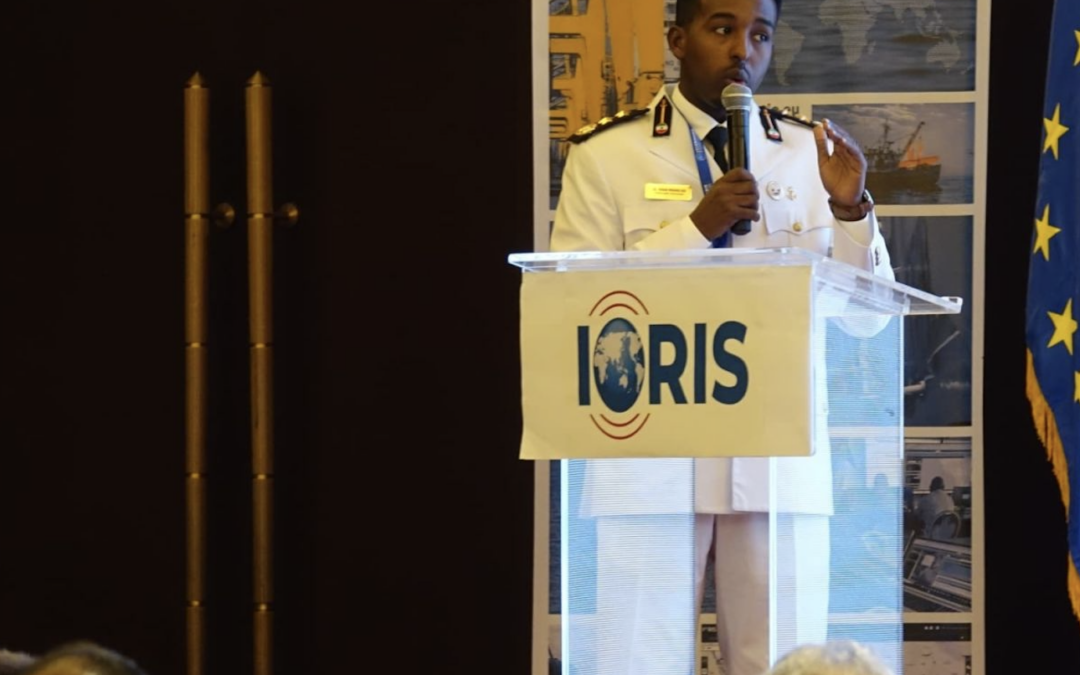
Operating along one of the region’s most strategic coastlines, the Somaliland Coast Guard plays a key role in maintaining maritime security. In this interview, Khadar Maxamed Ciise discusses operational challenges, regional cooperation and the growing impact of information sharing through IORIS.
What are the biggest operational challenges your agency encounters in securing vessels going in and out of the region?
Our biggest operational challenges arise when operating in and out of Somaliland waters. The Coast Guard is responsible for more than 850 kilometres of coastline, and our crews operate both within territorial waters and sometimes beyond them. Because of this wide area of responsibility, we face limitations in operational capability and in the availability of Coast Guard assets.
Another major challenge occurs during vessel movements—going in and out of various areas. There are many different phases in these operations, but a key issue throughout is communication. Effective communication is essential for both operations and daily activities, yet we sometimes face difficulties in maintaining it. In some places—especially within the Eastern and Western commands—communication systems are limited or not functioning well. This affects our ability to communicate with certain facilities or vessels that may not have adequate communication equipment. As a result, we are sometimes unable to get a clear understanding of real-time situations.
During operations, we also receive information from fishing boats or other type of boats, but limited communication capability makes it difficult to respond promptly. This lack of robust communication systems is one of our main operational challenges.
Some specialized vessels also do not have standard communication systems, such as AIS features while in some cases, they may intentionally switch these systems off when entering our territorial waters or when approaching areas of concern. This makes it harder to identify them and to understand their intentions.
How have evolving piracy tactics or regional instability impacted your security strategies in recent years?
We have not had any reported piracy cases recently. However, we remain vigilant because of our proximity to areas where piracy originates, particularly Somalia. We believe that if piracy groups become more capable and stronger, they could impact our national and maritime security across the Indian Ocean and, at times, even beyond.
At present, our territorial waters, our contingency zone, and our EEZ are secure and stable. But in the future, if piracy grows stronger and more influential, it could threaten our maritime security. Therefore, we are considering several tactics and measures to prepare for such a scenario.
One important tactic involves engaging with territorial and coastal communities. Since piracy often originates at land within these communities, we need to strengthen our relationships with local people—including fishermen, customs personnel, and others. Community awareness and advocacy programs are essential for building trust and preventing piracy from taking root.
Another key area is improving Coast Guard capability. Enhancing human resource capacity, technological capability, and operational readiness are all important steps toward preventing and responding to piracy-related activities in Somaliland and the wider region.
We also place significant emphasis on international engagement. One of Somaliland’s strategies has been to participate more actively in international forums to gather information on regional threats—especially regarding potential piracy vessels. Cooperation with maritime security agencies in neighbouring countries, such as Djibouti, Yemen, and Somalia, as well as with partners like the EU, is crucial.
Through information-sharing platforms such as IORIS and collaborative efforts, we can exchange data, tactics, ideas, and knowledge. Working together enhances our ability to counter piracy, disrupt their operations, and even influence the way potential piracy groups think before they attempt to organize.
What logistical or coordination difficulties arise when working with multiple regional authorities and international naval forces, such as EUNAVFOR ATALANTA, Combined Maritime Forces, and local coast guards?
There are some logistical difficulties, especially now. Standardization is very important when working with counterparts, such as neighbouring navies or friendly countries. When equipment and systems follow different standards, operations become harder to coordinate.
For example, during communication exercises—such as those involving the EU Naval Force’s Operation Atalanta—the systems used by different partners may not be compatible. Communication systems, command systems, or even exit and entry procedures can differ, and this affects decision-making during operations.
Logistical capability is also a significant factor. For instance, when working with regional or friendly counterparts on joint operations, if we do not have similar logistical capacity or compatible systems, it becomes difficult to coordinate and achieve shared objectives. So this is one of the important points to take into consideration.
We coordinate with regional naval forces—such as foreign naval commands—primarily through communication and information-sharing during operations, special missions, and incident responses. We use our communication systems and platforms to stay connected.
Recently, coordination and communication among maritime agencies across the region, including local organizations and international counterparts, has become extremely important. Sometimes we also use other communication channels, such as video links, especially when working in the same operational area.
For example, if our Coast Guard boats are operating near units from other naval forces, we can communicate directly via radio. In addition, during certain situations, we also communicate with EU Naval Forces and other maritime partners as needed.
At present, the main communication platform we use is IORIS, which enables us to see what other partners are sharing and allows them to see our updates as well. Although we do not have direct communication channels with every partner, IORIS brings all of us onto one shared platform. If we need to contact a partner privately or separately, we can still do so through the system.
What environmental or geographic factors (e.g., vast patrol areas, weather, chokepoints) create the most significant obstacles to maintaining consistent maritime security in the region?
Geographical factors pose significant impediments and serve as real obstacles to maintaining consistent maritime security in the region. The area contains several strategic maritime choke points, and we are extremely close to potential threats and vulnerabilities related to major maritime projects.
Protecting such important maritime channels is a shared responsibility for all countries in the region—especially for regional maritime law-enforcement agencies and Coast Guards. As Coast Guard, we believe that one of our core tasks, and indeed our obligation, is to play an important role in maintaining regional stability, international peace, freedom of navigation, and the free flow of trade. These elements are essential for the economic well-being of the entire region.
For this reason, securing critical maritime choke points—particularly ports and other maritime infrastructure—is of the utmost importance. Although our capabilities and operational effectiveness may sometimes be limited, we fully recognize our responsibility. We are committed to fulfilling our role in safeguarding the region and ensuring maritime security without compromising journalistic freedom or transparency in maritime affairs.
During the recent 3rd IORIS Steering Committee Policy Board and Working Group Meeting, priorities were identified to improve IORIS and strengthen its operational effectiveness. What are the priority improvements and follow-up actions needed to enhance usability and operational outcomes in your perspective?
We currently have only two operational centres, located in Hargeisa and Berbera. These centres use the IORIS platform. Along the wider coastline, we have three additional Coast Guard stations, but they still operate with their own systems and do not yet have fully suitable ICT and communication capabilities.
In my opinion, expanding across our entire coastline is essential. This will play a very important role in our future operations and in preventing potential threats or aggression. Because without capability, we cannot operate; and without information, we cannot take action at sea. Therefore, two areas are equally critical: improving operational capability through suitable assets such as boats and reliable communication systems and strengthening the information-sharing network. Without reliable information exchange, you simply cannot launch or coordinate operations.
For this reason, I strongly recommend expanding the IORIS platform across the Somaliland Coast Guard and also including other national maritime stakeholders. That would be the logical next step.
However, as mentioned, there are challenges. One major issue is that EU personnel cannot access some coastal locations because of security restrictions. This limits their ability to support us directly on site. As a result, officers must be brought to Hargeisa or Berbera for training, which can take one or even two days of travel. This logistical burden is significant. It becomes even more challenging when we consider officers from the more remote stations along the coast—some up to 350 kilometres away. Even when external experts arrive, they can only train a limited number of our personnel at a time.
Another obstacle is the limited availability of stable, fast internet and adequate hardware. Some stations do not even have proper equipment—computers, screens, or ICT tools—needed to run the system. So while expanding the IORIS platform is essential, we must also address these infrastructure gaps to ensure it can function effectively. These are important points to keep in mind as we plan the next phase of expansion.
We also have to remember that we need to follow the IT developments, hence what is really important is continuous receiving training to be updated.
How do you see the IORIS developments in the region?
Since we joined the IORIS community, the development of the Somaliland Coast Guard has improved day by day. At first, the platform was difficult for us to understand and operate. However, our operations centres in Hargeisa and Berbera have now become fully familiar with it. Our officers can use the system effectively and can even support senior officers during decision-making processes.
For example, before commanders such as the Admiral make any decision, they must first have proper and accurate information. Today, our IORIS operations team knows how to use the system well—how to share information, how to receive information from partner agencies across the region, and how to coordinate with relevant authorities.
A good example is our recent search-and-rescue operation, where we successfully saved a fisherman and recovered a missing fishing vessel. For the first time, through IORIS, Djibouti Coast Guard shared information immediately. Our operations officer in Hargeisa received the alert and informed us instantly. We then prepared and deployed our search-and-rescue teams. The operation was completed successfully thanks to very active coordination between Djibouti Coast Guard, the EU NAVFOR, and our own operations centres in Hargeisa and Berbera. This was a strong demonstration of how effective IORIS can be when used properly.
While our teams are motivated and ready to play their roles, we still need to expand the platform across the entire coastline.
The biggest challenges we face in expanding IORIS are:
- Logistics and accessibility:
Many remote coastal stations are difficult to reach. It can take officers one or two days to travel to Hargeisa or Berbera for training. - Limited infrastructure:
Several stations lack reliable internet, computers, screens, and other ICT equipment needed to operate the system. - Continuous training needs:
Personnel changes frequently. Even officers who were trained earlier may move to other roles, and new staff require ongoing training.
Because technology and the IORIS platform evolve continuously, training cannot be a one-time event. We need regular exercises and refresher courses to ensure the system is used effectively.
Despite these challenges, we are making continuous progress. Our capacity is improving, our teamwork is stronger, and the operational results—like the recent rescue—show that the investment in IORIS is truly valuable.
To know more about Somaliland Coast Guard: https://marines.govsomaliland.org