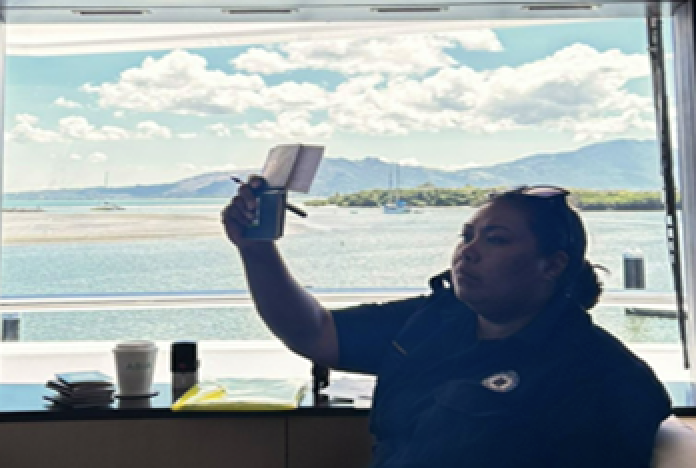
For International Women’s Day, we asked women across the maritime sector three questions about their careers, progress in the industry, and what still needs to change. This is what Adi Losana said.
What do you enjoy most about working in the maritime domain as a woman?
Working in the maritime area as a woman is quite challenging and interesting. The part I enjoy the most is being out there to control the movement of people in and out of Fiji and protect the sovereignty of my nation at the border.
What progress have you seen for women in the sector?
All-female operations working 24/7 shifts at the border. An increase in women in leadership and technical roles — including ship captains, wharf attendants, and border control officers.
What still needs to be done to better support women in the maritime sector
Supporting women in the maritime sector requires action at policy, institutional, operational, and cultural levels. While progress has been made globally, significant gaps remain—especially in leadership representation, safety at sea, and career progression.
Strengthen policy and legal frameworks
Organizations such as the International Maritime Organization (IMO) have promoted gender inclusion, but implementation at national and company levels remains uneven.
What still needs to happen:
o Mandatory gender equity policies within maritime administrations and shipping companies
o Clear anti-harassment and anti-discrimination regulations onboard vessels
o Strong reporting and whistleblower protection mechanism
o Gender-responsive maritime labour inspections
Countries should align maritime policies with international labour standards under the International Labour Organization (ILO), particularly protections under the Maritime Labour Convention (MLC).
Improve recruitment and access to maritime education
Women remain underrepresented in seafaring roles (globally estimated at around 2% of the seafaring workforce).
Key actions needed:
o Scholarships for women in nautical science, marine engineering, and naval architecture
o Targeted outreach in schools to normalize women in seafaring roles
o Mentorship programs pairing female cadets with senior officers
o Transparent recruitment criteria in maritime authorities
o Institutions such as the World Maritime University play a key role in advancing female leadership in maritime governance.
Address workplace culture & shipboard conditions
One of the biggest barriers is onboard culture and isolation.
Critical improvements needed:
- Zero-tolerance harassment policies enforced onboard vessels
- Gender-sensitive accommodation design (privacy, safety considerations)
- Safe reporting channels while at sea
- Mandatory diversity and inclusion training for crew
Without culture reform, retention will remain a major challenge.
Increase Representation in Leadership & Decision-Making
Women are particularly underrepresented in:
- Ship captains and chief engineers
- Port authority executives
- Maritime regulatory leadership
- Shipping company boards
- Border Control
Actions required:
- Leadership fast-track programmes
- Gender diversity targets in maritime boards
- Transparent promotion criteria
- Public reporting on gender ratios
Leadership visibility matters—role models shift industry norms.
Strengthen data collection and research
Reliable sex-disaggregated data in maritime remains limited.
We need:
- Annual national gender audits of maritime workforces
- Port and shipping company reporting obligations
- Research on safety, attrition, and career barriers
Evidence-based policy depends on measurable data.
Improve work-life integration
Seafaring contracts and long deployments can disproportionately affect women due to caregiving expectations. Possible reforms:
- Flexible rotation schedules
- Parental leave policies adapted to maritime contracts
- Shore-based pathways for experienced seafarers
- Reintegration programs after maternity leave
Promote regional and national commitment
For Pacific Island states, including Fiji, maritime is strategically important. National maritime authorities can:
- Integrate gender inclusion into maritime security strategies
- Ensure women are represented in port state control, border enforcement, and maritime surveillance
- Embed gender mainstreaming in maritime legislation for cultural transformation onboard ships
- Invest in female leadership pipelines