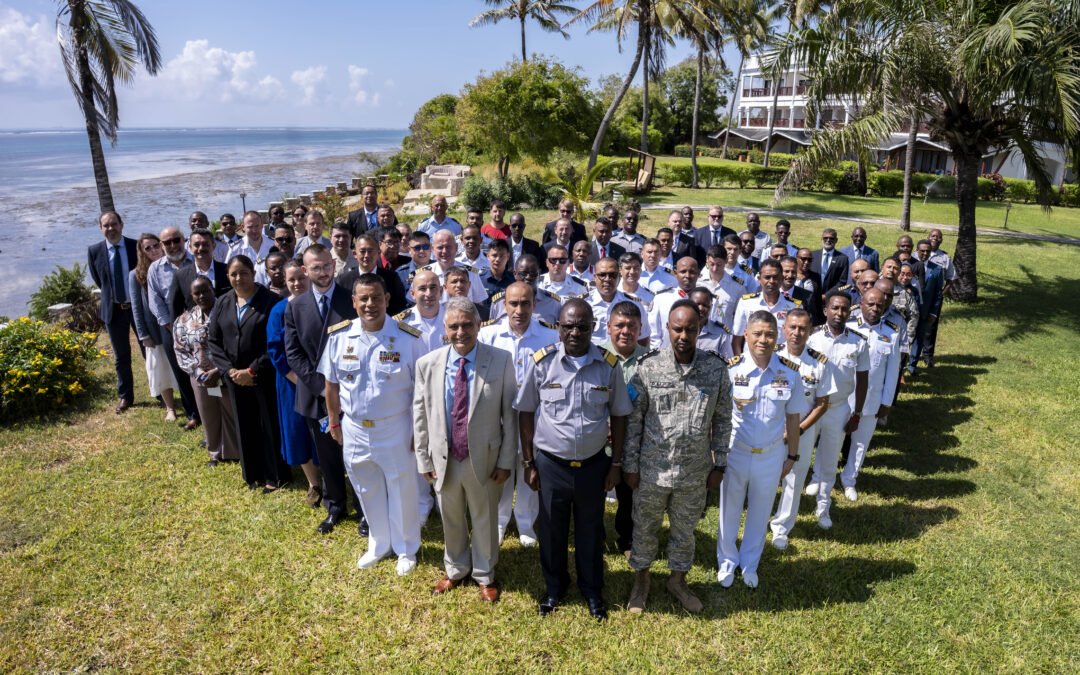
Over the next three days, more than 60 officials representing over 30 countries meet in Mombasa, Kenya, for the 4thIORIS Steering Committee Policy Board and Working Groups Meeting, co- hosted by the Kenya Coast Guard Service (KCGS) and the European Union, and organised by the EUCRIMARIO project. Their shared objective is to make the sea safer and more secure through closer cooperation between maritime organisations and entities, across borders and across sectors, facilitated through IORIS – the coordination and information-sharing platform developed and implemented by EUCRIMARIO since 2018.
Mr. Bruno I. Shioso, EBS, OGW, Director General of the Kenya Coast Guard Service, welcomed participants: “The waters off our coast connect us to the whole Indian Ocean, and so do the challenges we face there. Information shared in time can save lives and stop crime. By strengthening how we cooperate with our regional and international partners with the support of IORIS, we are building a safer and more secure maritime environment for our seafarers, our fishing communities and our economy.”
Antoine Hanin, Programme Manager, Security Governance and Maritime Security, for the European Commission, co-hostig the event, affirmed: “The security of the sea is the foundation of trade, livelihoods and stability for all of us. Kenya and the European Union share a strong commitment to a peaceful and rules-based maritime order, and today’s meeting shows what that commitment looks like in practice: agencies from many countries choosing to work side by side. The European Union will continue to stand with its partners in this effort.”
Recognising that threats at sea transcend national jurisdictions, participants will focus on how agencies can work together more effectively – nationally between authorities, and internationally between neighbouring countries and regions. Partner agencies will present IORIS success stories showing how the platform supports real operations, while the results of the ISC 2026 survey will help shape priorities for the year ahead.
“IORIS is only as strong as the cooperation behind it,” said Martin Cauchi Inglott, EUCRIMARIO Director. “Over the years, IORIS has grown from a technical tool into a genuine community of maritime organisations and entities that trust one another. This meeting is where that community decides together how to work better: with shared procedures, solutions tailored to each sector and a clear legal framework. Cooperation is what makes the sea safer, and IORIS is the space where it happens.”
A central item on the agenda is the Regional IORIS Standard Operating Procedures (SOP) Version 2.0. Working by region, participants will explore how to harmonise the way they collaborate through the platform, so that alerts, requests for assistance and information exchanges follow common, predictable steps across agencies and countries.
Officials will also discuss the evolution of the platform, including the launching of the IORIS Mobile Phone Application and the MARCOM App, IORIS security, and feedback from the regional hubs. Sectoral discussions on the development of IORIS variants will address the specific needs of port and ship security, Search and Rescue (SAR) and the fight against illegal, unreported and unregulated (IUU) fishing. The Operational Working Group will review the use of IORIS in real operations and examine operational enhancements proposed by partners, while the Policy Board will consider the steps needed to implement IORIS operational capability at the level of each authority.
Meanwhile, the Legal Working Group will address memoranda of understanding and data protection, the handling of digital evidence to ensure that cooperation through IORIS rests on a sound and trusted legal basis.
The meeting will close on 12 November with conclusions from the Working Group Chairs and concluding remarks by EUCRIMARIO and the Kenya Coast Guard Service.