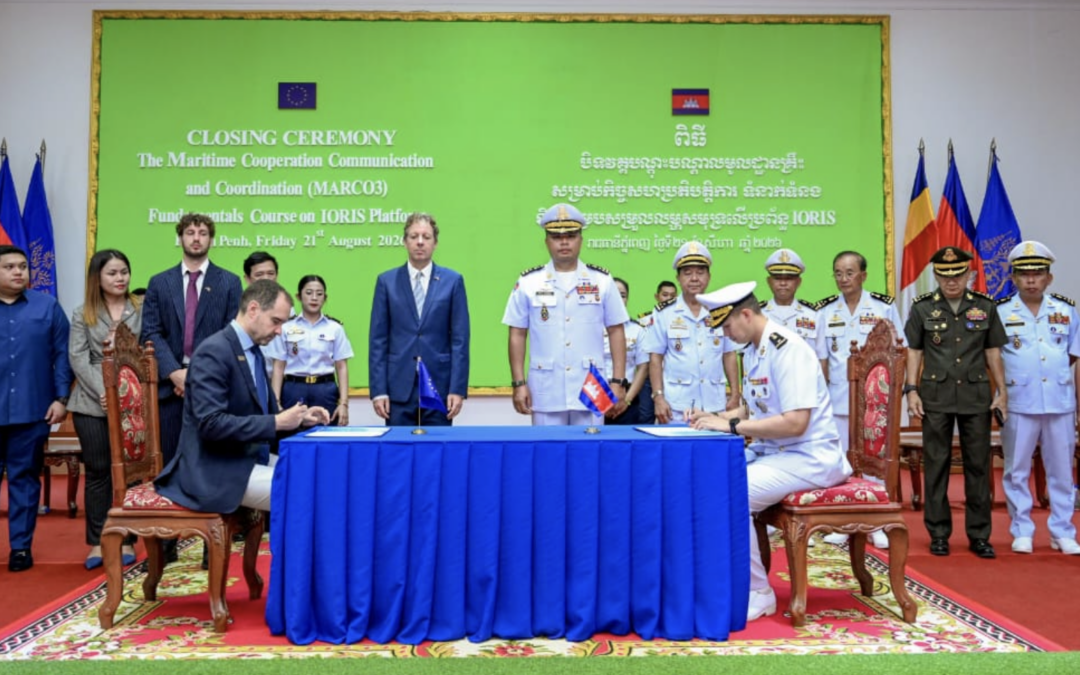
From 17–21 August 2026, EUCRIMARIO conducted an IORIS MARCO3 Fundamentals Course in Phnom Penh, bringing together representatives of the Royal Cambodian Navy (KHM Navy) for five days of training, exchange and practical engagement.
The activity marked an important milestone for EUCRIMARIO’s engagement in Southeast Asia, as it was both the first IORIS training organised in Cambodia and the first EUCRIMARIO activity conducted in the country. It provided an opportunity to introduce participants to IORIS and its functionalities, while exploring how the platform can contribute to maritime information exchange, coordination and operational cooperation.
Over the course of the week, participants worked through the MARCO3 Fundamentals syllabus, combining theoretical sessions with practical exercises designed to familiarise them with the platform and its potential applications. The training also created space for discussion and exchange on the operational realities faced by maritime actors and on the importance of timely information sharing in supporting maritime security and safety.
Participants showed strong interest and active engagement throughout the course, contributing their own experience and perspectives to the different sessions and exercises. Their involvement helped make the training not only an introduction to the technical functionalities of IORIS, but also an opportunity to discuss how digital tools can support greater coordination and cooperation among maritime stakeholders.
The participation of senior representatives of the Royal Cambodian Navy, including the Deputy Chief of Staff, further highlighted the importance attached to exploring tools and approaches that can contribute to more effective maritime coordination and situational awareness. Representatives of the European Union Delegation (EUD) also joined the activity. Their participation reflected the shared commitment to strengthening maritime security and safety and to supporting continued cooperation and dialogue with Cambodian maritime stakeholders.
From training to operational exploration
A key outcome of the week was the signing of the IORIS Trial Agreement during the closing ceremony. The agreement provides the Royal Cambodian Navy with a four-month trial period during which it can continue exploring the platform and assess its potential relevance and operational value within Cambodia’s own maritime security context. This next step will allow participants to move beyond the training environment and further familiarise themselves with IORIS, considering how its information-sharing, tracking and analytical functionalities could support their work and facilitate coordination.
The practical value of these functionalities was also reflected in participants’ feedback at the end of the course. Jr. Warrant Officer Tao Kimsrun highlighted the platform’s potential contribution to information sharing and operational decision-making: “The IORIS platform can have a direct impact on real-time maritime information sharing, improve response times during joint operations across agencies, and enhance tactical decision-making through its tracking and analysis tools.”
LT Keo Chanbilly similarly underlined the value of the training in demonstrating how stronger information exchange can support cooperation between maritime actors: “The IORIS platform gave me a better understanding of how maritime agencies can share information and work together more effectively to support maritime security and cooperation. Overall, the training was a valuable experience that I can apply to my work, and I am grateful for the opportunity to learn, connect and contribute to stronger maritime cooperation.”
The feedback reflects an important element of IORIS training: beyond learning how to use the platform itself, participants are encouraged to consider how improved information exchange can strengthen connections between maritime actors and contribute to faster, better-informed and more coordinated responses.
A growing IORIS community in Southeast Asia
The activity in Cambodia also represents another step in the continued expansion of IORIS engagement across Southeast Asia. With Cambodia joining the network, four ASEAN countries are now using IORIS: Cambodia, the Philippines, Thailand and Vietnam. Indonesia has also received IORIS training, further extending knowledge of the platform and its potential contribution to maritime information exchange and cooperation in the region.
This growing engagement is particularly significant in a maritime environment where many challenges extend beyond national boundaries. Effective responses depend not only on national capabilities, but also on the ability of maritime actors to communicate, exchange relevant information and coordinate when necessary.
By bringing more maritime stakeholders into contact with common tools and approaches, IORIS training contributes to developing a stronger foundation for cooperation. Each new activity also provides opportunities to exchange experiences, better understand different operational contexts and identify areas where greater connectivity between maritime actors can add value.
Cambodia’s engagement therefore contributes to a wider regional dynamic. As familiarity with IORIS continues to grow across ASEAN countries, so too does the potential for stronger connections among maritime security actors and for more effective information exchange across the region.
Building cooperation through dialogue and trust
The Phnom Penh training demonstrated once again that effective maritime cooperation is built not only through technology, but also through dialogue, trust, shared knowledge and the willingness to work together. Training activities such as this create opportunities for maritime professionals to learn from one another, develop practical connections and explore common approaches to shared maritime challenges. The signing of the IORIS Trial Agreement now provides an opportunity for the Royal Cambodian Navy to continue this process and assess how IORIS can best contribute to its operational needs.
As EUCRIMARIO continues to engage with maritime partners across Southeast Asia and the wider Indo-Pacific, these exchanges contribute to a broader objective: supporting a more connected maritime community capable of sharing information, building mutual understanding and working together towards safer and more secure seas.
At sea, cooperation matters. By sharing knowledge, experience and perspectives, together we are stronger.