As recent episodes in the Red Sea have demonstrated, one of the most significant maritime challenges today is the transit through high-risk areas—particularly for oil tankers. Beyond the potential economic losses, the environmental consequences of an incident could be even more severe.
Similar situations may be faced by any oil company worldwide; therefore, preparedness for a wide range of scenarios is essential. With this objective in mind, a Tabletop Exercise (TTX) was organised by the Royal Thai Navy (RTN) together with PTT Public Company Limited (PTT), a Thai state-owned, SET-listed petroleum and natural gas company, with the support of the EU CRIMARIO project.
The objective of the Tabletop Exercise was to develop and validate coordination procedures that enhance strategic understanding and effectiveness of coordination and control mechanisms for commercial vessels between the Royal Thai Navy and PTT Public Company Limited. At a broader level, the exercise aimed to reinforce structured cooperation with ship-owning companies and commercial shipping stakeholders, strengthening civil–military partnerships to ensure the security and resilience of maritime routes supporting international trade.
The exercise focused on testing coordination and information exchange between RTN and PTT during the passage of commercial vessels—particularly those carrying highly sensitive cargo such as crude oil—through high-risk areas.
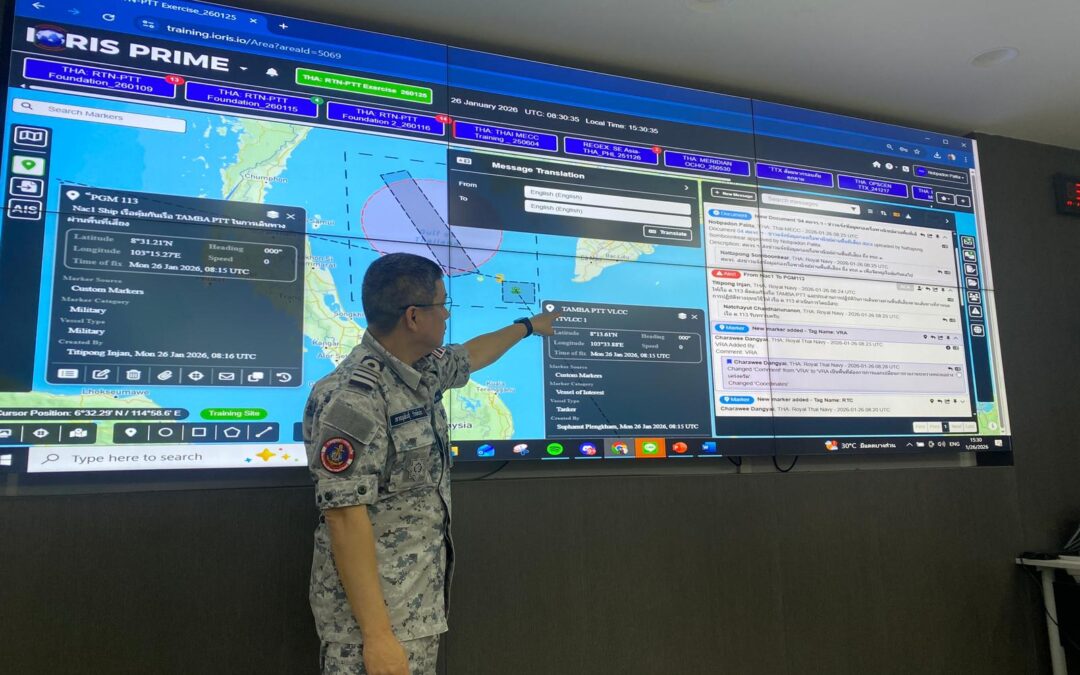
More specifically, participants were requested to practise, via the IORIS platform, exchanging communication between the two institutions aimed at accompanying and protecting PTT vessels using RTN assets.
As both organisations had received training on IORIS in the days preceding the exercise, the platform proved to be particularly well suited for supporting the scenario and meeting the exercise objectives.
At the end of the exercise, during the debriefing session, participants shared feedback on the effectiveness of the platform. As reported by Captain Panuphun Rakkeo, Head of Maritime Law Enforcement Division, Royal Thai Navy:
“Due to its specific capabilities, IORIS helped partners create a very clear and useful common operational picture, which enabled participants to have a shared understanding of the situation at sea, particularly concerning the positioning of the vessels and of their possible future actions.”
He further added:
“Designed to mainly support information exchange and coordination between partners, IORIS played a key role in the exercise by enabling participants to inform each other on their intentions, actions and results of their actions. The constant information exchange between participants enabled a open and constructive collaboration which increased the level of trust and confidence between the two organizations. The use of IORIS was very beneficial particularly in enabling the establishment of a common operational picture accessible at any moment for all actors and in facilitating the testing and improvement of the existing dedicated SOP.”
Commenting on the exercise, Alexandru Chiric Southeast Asia representative of the EU CRIMARIO project stated:
“It has been a real pleasure to support and organise an activity of this quality. The high level of competence, professionalism and engagement demonstrated by all participants clearly showed the value of regular joint exercises. Scenarios such as this one highlight how, even in high-risk maritime areas, improved coordination and information sharing can help prevent incidents and reduce risks. We were particularly pleased to see IORIS perform as expected, effectively supporting decision-making and cooperation throughout the exercise.”
Following the success of the TTX, a live exercise may be organised in the coming months, again making use of the IORIS platform to further test procedures and operational coordination in real-time conditions.
This exercise highlighted the critical importance of preparedness, coordination, and information sharing when navigating high-risk maritime areas. In an increasingly complex maritime security environment, effective collaboration between military authorities and the civilian sector—supported by reliable digital tools such as IORIS—remains essential to mitigating risks, protecting critical cargoes, and preventing incidents with potentially severe economic and environmental consequences.