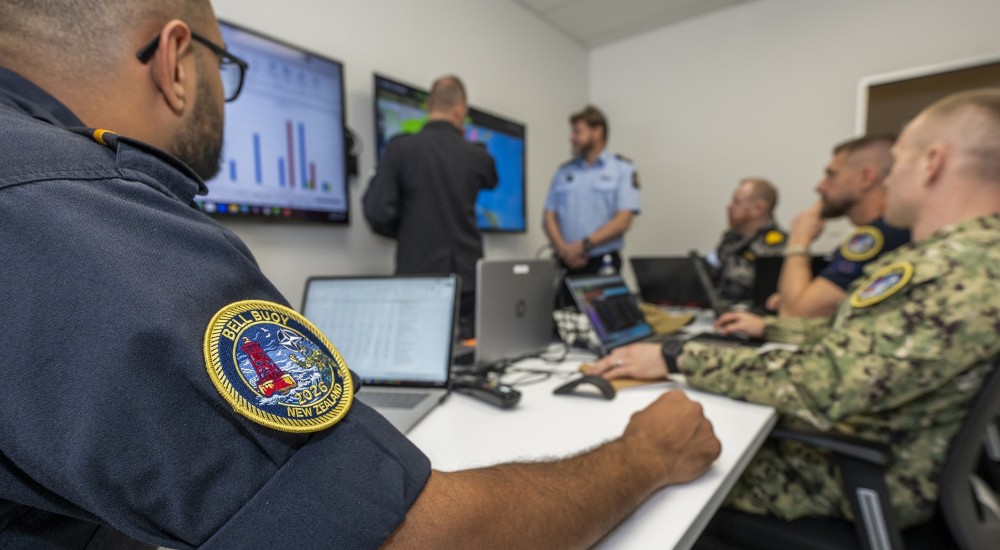
Exercise Bell Buoy concluded on 1 May after 2 weeks of intense operational activity in Auckland, New Zealand, bringing together international military and maritime partners to strengthen cooperation in an increasingly complex global security environment.
Bell Buoy is designed to train personnel engaged in Naval Cooperation and Guidance for Shipping (NCAGS) and Maritime Trade Operations (MTO). It focuses on protecting commercial shipping, enhancing maritime domain awareness, and improving coordination among partner nations during crisis scenarios.
This year’s edition brought together representatives from Australia, Canada, Ecuador, France, the Philippines, the Republic of Korea, Singapore, the United Kingdom, New Zealand, and the United States. More than 42 participants, including NATO and PACIOSWG (Pacific and Indian Ocean Shipping Working Group) representatives, took part in the exercise. The primary objective was to strengthen international cooperation and coordination among NCAGS/MTO units operating in an escalating security scenario.
For the third consecutive year, EU CRIMARIO supported Exercise BELL BUOY by providing IORIS as the primary communication and coordination platform linking commercial shipping stakeholders and participating military personnel. An EU CRIMARIO Exercise Planner was deployed to New Zealand to deliver initial training and provide continuous support to participants and the Exercise Control (EXCON) team throughout the exercise. This support ensured the effective integration and full operational use of IORIS across the exercise scenario, facilitating structured information sharing, real-time coordination, and enhanced situational awareness between maritime trade and naval stakeholders.
The exercise included a wide range of operational simulations aimed at ensuring the safety of seafarers and the continuity of maritime trade during conflicts, piracy incidents, and other crises. Participants trained on maritime interdiction operations (MIO), navigation through maritime threats scenarios, while military and maritime industry experts worked together on tactics, techniques, and procedures for protecting commercial vessels.
Throughout the exercise, IORIS served as the sole communication tool used to compile and maintain a Common Operating Picture (COP), ensuring full situational awareness for all participants during the implementation of the scenarios. The platform also acted as the primary communication channel between units operating from different simulated locations.
“IORIS proved to be a very effective tool throughout the exercise, allowing all participating units to stay connected and share information in real time. It helped create a common operational picture for everyone involved and made coordination between teams in different locations much smoother. Participants were very positive about using the platform, as it facilitated communication and cooperation throughout the different scenarios,” affirmed EU CRIMARIO Exercise planner.
With 99 per cent of New Zealand’s imports and exports transported by sea, the protection of maritime trade routes remains a strategic priority. Commodore Arndell, participating in the exercise, underlined the importance of securing sea lanes at a time of growing geopolitical instability. “The deteriorating strategic environment in the Indo-Pacific, and indeed the world, is requiring us to be more alert of the potential for impacts to our vital shipping links to international markets,” he said.
Indeed, across the world, safe passage for merchant shipping and freedom of navigation are more relevant today than at any time in recent years.
Captain Cannon Neslen, U.S. Pacific Fleet NCAGS Director, said the global merchant shipping industry is facing “unprecedented” security challenges. He stressed the importance of exercises such as Bell Buoy in strengthening cooperation between civilian and military maritime stakeholders: “It highlights the importance of the MTO teams communicating with key shipping and country stakeholders in understanding the array of commercial and military risks.”
Sub Lieutenant Amos Kamo, a Maritime Trade Operations reservist with Auckland-based unit HMNZS Ngapona, highlighted how current global events have reinforced the relevance of the training: “Everything that is playing out over there, is everything we have trained for” he said. “People have become a lot more interested in what we do, and they can see the relevance of it.” “The real highlight for us is spending time with other countries, getting to know other people and getting a great sense of how they take their military doctrine and effect it. You see a lot of competency and confidence and it’s really cool to absorb it.”
As maritime security challenges continue to evolve, exercises such as Bell Buoy demonstrate the importance of international cooperation, information sharing, and strong coordination between military and civilian partners. By working together and building mutual understanding, participating nations strengthen their collective ability to safeguard global trade routes and respond effectively to future crises.